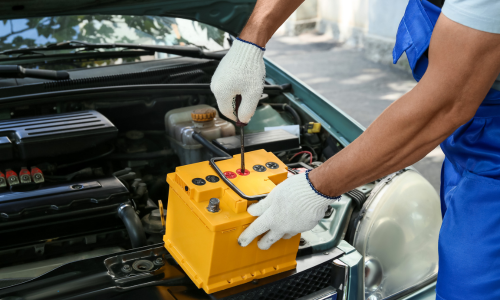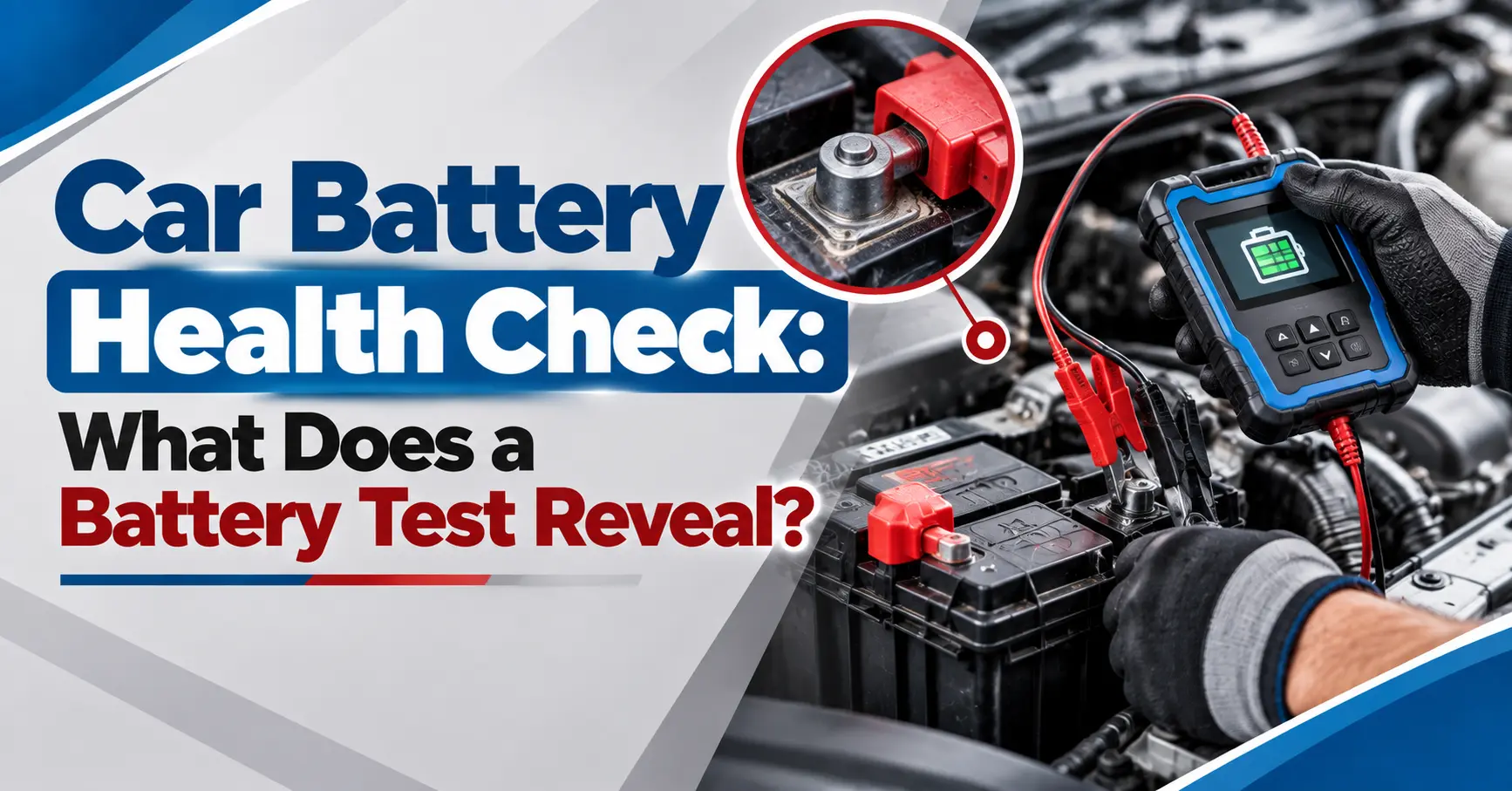
A car can sometimes start normally even when its battery is already losing performance. Checking only whether the engine starts does not provide a complete picture of battery condition.
A professional car battery health check in Sharjah can provide more useful information about the battery’s charge level, starting capability and overall condition. Depending on the test equipment and battery type, the technician may assess voltage, state of charge, cold cranking capability, internal resistance and cranking performance. The vehicle’s charging system may also be checked to determine whether the alternator is supplying the battery correctly.
This matters because a starting problem does not always mean the battery itself has failed. A low charge, alternator issue, poor connection or another electrical problem can produce similar symptoms.
So, what does a battery test actually reveal?
Let’s break down the main measurements and what they mean.
Quick Answer: What Does a Car Battery Test Reveal?
A professional battery test can help determine:
- Battery voltage
- State of charge (SOC)
- State of health (SOH)
- Cold cranking performance
- Cranking-voltage drop
- Battery internal condition
- Whether the battery may need charging
- Whether the battery may be nearing replacement
- Whether the charging system needs further investigation
Depending on the equipment, a diagnostic test may also evaluate the alternator, starter-related performance and electrical-system behaviour.
The result should be interpreted according to the battery type, manufacturer’s specifications and the testing equipment being used.
What Is a Car Battery Health Check?
A battery health check is a diagnostic assessment of the battery rather than simply a visual inspection.
A technician may combine:
Visual inspection → Voltage test → Battery health/CCA test → Cranking test → Charging-system test
The exact sequence depends on the vehicle, battery technology and diagnostic equipment.
For modern vehicles, checking only voltage may not be enough to understand battery condition. VARTA notes that state of charge can be assessed with voltage, while state of health requires a more detailed test that can consider factors such as cold-start capability, remaining capacity and charge acceptance.
1. Battery Voltage: Is the Battery Charged?
Voltage is one of the first measurements a technician may check.
For a conventional 12-volt automotive battery, an open-circuit voltage around 12.6–12.8V can indicate a high state of charge under appropriate test conditions. A lower reading can indicate that the battery is undercharged, although voltage alone does not prove that the battery is healthy or defective.
This distinction is important.
A Low Voltage Reading Can Mean:
- The battery is discharged
- The vehicle has not been driven enough to recharge it
- There may be a charging-system problem
- The battery may have deteriorated
Therefore:
Low voltage ≠ automatically “replace the battery.”
The battery may need charging and retesting before a replacement decision is made. AAA describes test outcomes such as “Good – Recharge” and “Charge and Retest” for situations where the battery’s charge level is low but its underlying condition has not yet been established.
2. State of Charge (SOC): How Much Charge Is Available?
State of Charge (SOC) refers to how much charge the battery currently has.
Think of it as the battery’s current charge level.
A battery may have:
- High state of charge
- Moderate state of charge
- Low state of charge
- Very low or discharged condition
SOC is useful, but it is not the same as battery health.
For example, a battery could be fully charged but still have reduced ability to deliver starting power because of age or internal deterioration.
That is why a complete battery assessment should go beyond voltage or SOC.
3. State of Health (SOH): How Well Is the Battery Performing?
State of Health (SOH) is different from state of charge.
SOH attempts to indicate how the battery’s present performance compares with its expected condition.
A battery with:
High SOC + Poor SOH
can be fully charged but still have reduced starting capability.
This is one reason a car can start normally on one day and struggle after the vehicle has been parked for several hours or under a heavier starting load.
Modern battery testers can evaluate parameters such as battery condition, CCA and related performance characteristics, depending on the tester and battery technology.
4. CCA: Can the Battery Deliver Starting Power?
CCA stands for Cold Cranking Amps.
It is a standard way of describing a battery’s starting-performance capability. AAA identifies CCA as an industry-standard battery performance rating.
A battery may still show reasonable voltage while its ability to deliver the required starting current has declined.
A battery test can compare the measured starting capability with the battery’s rated or expected CCA.
This is particularly useful when diagnosing:
- Slow engine cranking
- Intermittent starting issues
- Repeated jump starts
- Older batteries
Al Bayan’s current service information states that its technicians check cranking power and match replacement batteries according to relevant AH and CCA requirements when a car battery replacement is necessary.
5. Cranking Test: What Happens When You Start the Engine?
A battery may appear healthy when the car is switched off but behave differently when the starter motor demands significant current.
A cranking test evaluates how battery voltage behaves while the engine is being started.
If voltage drops excessively during cranking, it can indicate a battery or electrical-system problem that deserves further diagnosis.
Battery diagnostic systems can measure voltage drop during cranking alongside battery CCA and other parameters.
This makes the cranking test useful because it evaluates the battery under a real starting demand rather than only looking at resting voltage.
6. Load Test: How Does the Battery Perform Under Demand?
A traditional load test places an electrical load on the battery and observes how well it maintains voltage.
For example, manufacturer testing procedures may apply a load related to the battery’s rated CCA for a defined period and then compare the resulting voltage against temperature-adjusted specifications.
A weak battery may fail to maintain the required voltage under load.
However, testing criteria vary according to battery type, temperature and manufacturer specifications, so there should not be one universal pass/fail voltage applied to every vehicle.
7. Internal Resistance and Conductance
Some modern electronic battery testers use conductance or related measurements to assess battery condition.
These systems can provide information about:
- Battery voltage
- Internal resistance/conductance characteristics
- State of charge
- State of health
- Starting capability
VARTA notes that modern battery testing for technologies such as AGM and EFB requires equipment appropriate to the battery technology.
This is particularly relevant because modern vehicles may use different battery technologies rather than a conventional flooded lead-acid battery.
8. Does the Battery Hold Its Charge?
A battery that repeatedly loses charge needs investigation.
The problem could be:
- Battery deterioration
- Parasitic electrical drain
- Charging-system fault
- Infrequent use
- Loose or poor connections
A battery test can help identify whether the battery itself is weak, but additional electrical testing may be necessary when repeated discharge is involved.
Interstate and DENSO both note that a battery can appear charged while still having insufficient overall performance, and excessive parasitic electrical loads can contribute to battery discharge.
9. Alternator and Charging-System Check
A battery does not operate independently.
Once the engine is running, the charging system replenishes the battery and supplies electrical power to vehicle systems.
Therefore, if the battery keeps going flat, the technician may also check:
- Alternator output
- Charging voltage
- Electrical connections
- Charging-system behaviour
- Possible abnormal current draw
Al Bayan’s current service information states that its mobile diagnostics include alternator and charging-system checks before recommending battery replacement.
This can prevent a common mistake:
Replacing the battery while leaving the actual charging-system problem unresolved.
10. Starter-System Performance
The starter motor requires substantial electrical power from the battery.
If the vehicle is slow to crank, the battery may be involved, but the starter circuit should not automatically be ruled out.
Depending on the diagnostic equipment, a comprehensive battery/starting-system test can help assess:
- Battery output
- Cranking voltage
- Starter-related electrical demand
- Cable voltage drop
Some advanced diagnostic systems are designed to evaluate battery, alternator, starter and circuit health together.
11. Battery Terminals and Connections
A battery can be in good condition while the connection between the battery and vehicle is poor.
The technician should inspect for:
- Corrosion
- Loose terminals
- Damaged cables
- Poor contact
- Contamination
- Improper connections
A connection problem can produce starting symptoms that appear to be battery-related.
That’s why physical inspection remains an important part of a battery health assessment rather than relying exclusively on an electronic test.
12. Physical Battery Condition
A battery health check may also reveal visible warning signs such as:
- Cracks
- Leakage
- Bulging or swelling
- Damaged terminals
- Severe corrosion
- Loose mounting
A damaged or swollen battery should be handled professionally rather than repeatedly tested or used.
A physical inspection also helps identify problems that a voltage or electronic health test cannot detect.
What Do Different Battery Test Results Mean?
A diagnostic report may produce different recommendations depending on the tester.
“Good Battery”
The battery is performing within the relevant test parameters and does not currently indicate replacement.
AAA describes a “Good Battery” result as a battery measuring within the manufacturer’s required CCA specification.
“Good – Recharge”
The battery may be in acceptable condition but currently have a low state of charge.
A recharge may be recommended before further assessment.
“Charge and Retest”
The battery voltage may be too low for an accurate condition assessment.
The battery should be charged and tested again.
“Replace Battery”
The test indicates that the battery is no longer meeting the relevant performance criteria.
The exact replacement decision should still consider the vehicle, battery specifications and test conditions.
“Bad Cell”
A test may indicate an internal cell failure.
AAA describes this result as indicating failure in one or more battery cells.
Does a Battery Test Tell You Exactly How Many Months Are Left?
No.
A battery health test provides a snapshot of the battery’s present condition. It does not provide a guaranteed expiration date.
A battery can pass a test today and deteriorate later because battery performance changes with:
- Age
- Temperature
- Usage
- Charging conditions
- Vehicle electrical demand
- Battery chemistry
Therefore, a result such as “Good” means the battery is currently testing within the applicable parameters. It should not be interpreted as a guarantee that the battery will remain healthy for a specific number of months.
Can a Weak Battery Be Recharged Instead of Replaced?
Sometimes.
A battery may simply have a low state of charge while remaining serviceable.
For example:
Low Charge → Recharge → Retest → Continue Using
may be appropriate.
But:
Failed Battery Test → Replacement
may be appropriate when the battery cannot meet the relevant performance criteria.
AAA explicitly distinguishes a battery that is “Good – Recharge” from one that should be replaced.
This is why testing before replacement can be valuable.
Battery Test vs Battery Replacement: What’s the Difference?
A battery test answers:
“What condition is my current battery in?”
A battery replacement answers:
“What new battery should be installed if the current one has reached the end of its useful service?”
These are different services.
Testing should ideally come before an unnecessary replacement.
Al Bayan’s current battery-replacement service states that it performs battery health testing, alternator checks and electrical assessment before determining whether replacement is required.
When a replacement is actually required, the company states that the new battery is matched according to factors including AH, CCA, terminal layout and OEM specifications.
When Should You Get a Car Battery Health Check?
A battery check can be useful when you notice:
- Slow engine cranking
- Repeated jump-start requirements
- Intermittent starting problems
- Battery warning-light activity
- Electrical irregularities
- A recurring discharged battery
- An older battery
- Problems after the vehicle has been parked for an extended period
It can also be useful before a long trip when you want to understand the current condition of the starting and charging system.
The purpose is not to predict the future perfectly, but to identify current battery or electrical issues before they become a breakdown.
Is a Battery Health Check Useful Before a Long Trip?
Yes.
A pre-trip battery check can help identify:
- Low state of charge
- Reduced starting capability
- Weak battery condition
- Charging-system issues
- Poor connections
AAA’s current battery-maintenance guidance recommends professional battery diagnostics as part of maintenance, particularly where battery age, starting behaviour or operating conditions raise concern.
For a driver travelling between Sharjah, Dubai, Ajman or longer UAE routes, identifying a battery problem before departure can be more convenient than discovering it in a parking area or roadside location.
Why Battery Testing Matters in Sharjah
Sharjah drivers can experience demanding vehicle operating conditions, including high temperatures, air-conditioning loads, traffic and periods of stop-and-go driving.
Current AAA guidance notes that extreme heat, frequent short trips and advanced vehicle electronics can shorten battery life.
However, it would be inaccurate to assume that every battery in Sharjah will last for exactly a particular number of years.
Actual battery condition should be assessed through testing + vehicle history + usage + battery age + charging-system performance.
That is why a battery health check can be more useful than relying on age alone.
How a Mobile Battery Health Check Works in Sharjah
A mobile diagnostic visit can generally follow this sequence:
Step 1: Vehicle Information
Provide:
- Car make
- Model
- Model year
- Engine details if known
- Current battery information
- Location in Sharjah
Step 2: Visual Inspection
The technician checks the battery, terminals, cables and mounting condition.
Step 3: Battery Test
The technician measures the relevant battery parameters using appropriate testing equipment.
Step 4: Cranking Assessment
Starting performance may be checked where appropriate.
Step 5: Charging-System Check
The alternator and charging system may be evaluated if the symptoms suggest a charging issue.
Step 6: Explain the Result
The result should distinguish between:
Healthy → Recharge → Retest → Further Diagnosis → Replacement
rather than treating every weak-starting symptom as an automatic replacement.
Al Bayan’s current service pages state that its mobile technicians perform battery health testing, cranking assessment, alternator/charging checks and post-service testing.
What Should You Do After the Battery Test?
The next step depends on the result.
| Test Result | Possible Next Step |
|---|---|
| Good | Continue using and monitor |
| Low charge | Recharge and retest if appropriate |
| Charge & retest | Recharge before final diagnosis |
| Weak CCA / poor health | Consider replacement |
| Bad cell | Replacement may be required |
| Charging-system problem | Diagnose alternator/electrical system |
| Connection problem | Clean/repair connection and retest |
| Excessive current draw | Investigate parasitic drain |
The table is a general diagnostic framework. The actual recommendation should follow the battery manufacturer’s specifications and vehicle-specific testing procedure.
How Often Should You Test a Car Battery?
There is no single interval that applies to every vehicle.
Testing becomes especially relevant when:
- The battery is aging
- Starting performance changes
- The vehicle is driven infrequently
- The car has repeated electrical issues
- The vehicle has recently required jump starts
- You are preparing for a long journey
Some battery manufacturers recommend proactive periodic testing; Tata Green, for example, recommends testing automotive batteries twice a year as a maintenance practice.
For an individual vehicle, the appropriate frequency should consider the battery type, age, usage pattern and manufacturer’s recommendations.
Battery Health Check for Different Vehicle Types
Battery testing is not limited to small cars.
It can be relevant for:
- Sedans
- Hatchbacks
- SUVs
- 4×4 vehicles
- Pickup trucks
- Vans
- Commercial vehicles
- Fleet vehicles
The required battery specification can differ substantially between vehicles.
Al Bayan currently states that its battery service covers Japanese, Korean and European vehicles as well as SUVs, pickups, vans and commercial fleets.
When a Battery Health Check Leads to Car Battery Replacement
A test can reveal that the battery is no longer capable of delivering the required starting performance.
When that happens, the next step is choosing the correct replacement.
Important specifications may include:
- Battery size
- AH rating
- CCA rating
- Terminal layout
- Battery technology
- Manufacturer requirements
- Vehicle electrical-system requirements
Some vehicles use AGM or EFB batteries, particularly where start-stop technology and higher electrical demands are involved. VARTA notes that different battery technologies require appropriate testing equipment and procedures.
For customers whose battery test confirms replacement is necessary, Al Bayan’s Car Battery Replacement service provides mobile replacement across Sharjah, Ajman and Dubai.
Frequently Asked Questions
What does a car battery health test check?
A battery test can assess parameters such as voltage, state of charge, state of health, CCA and starting performance. A wider diagnostic can also examine alternator and charging-system performance.
Does a battery test tell me if I need a new battery?
It can help determine whether the battery is performing within its applicable specifications. Results such as poor health, failed load testing or a bad cell can indicate that replacement should be considered.
Can a battery test show a charging-system problem?
A battery health check can be combined with an alternator and charging-system test to investigate whether the vehicle is properly replenishing the battery.
What does CCA mean on a battery test?
CCA means Cold Cranking Amps and represents a battery’s rated starting-performance capability. A diagnostic test can compare measured starting performance with the applicable battery specification.
Is 12.6 volts enough to prove a battery is healthy?
No. A voltage reading mainly provides information about charge level under the relevant test conditions. A battery can show a good voltage reading while still having reduced starting capability or internal deterioration.
What does “Good – Recharge” mean on a battery test?
It generally means the battery appears to be in acceptable condition but has a low charge level. Recharging and subsequent testing may be recommended.
What does “Charge and Retest” mean?
The battery voltage may be too low for the tester to make a reliable condition assessment. After charging, the battery can be tested again.
Can a battery pass a test and still fail later?
Yes. A battery test describes its condition at the time of testing. Battery performance can change with age, temperature, usage and charging conditions.
Should I test my battery before a long trip?
A pre-trip check can identify low charge, reduced starting performance or charging-system issues before you leave. This can be particularly useful when the battery is older or has recently shown warning signs.
Can a mobile technician test my car battery in Sharjah?
Al Bayan currently states that its mobile technicians perform on-site battery health, cranking and charging-system checks in Sharjah, with coverage also extending to Ajman and Dubai.
Final Thoughts
A car battery health check in Sharjah can tell you much more than whether your car starts today.
A useful diagnostic can help answer:
Is the battery charged? → Is it still healthy? → Can it deliver sufficient starting power? → Is the charging system working properly? → Does it need charging, further diagnosis or replacement?
The key measurements can include voltage, SOC, SOH, CCA, cranking performance and charging-system behaviour.
Most importantly, don’t treat one low-voltage reading as automatic proof that the battery must be replaced. A proper diagnosis distinguishes between a discharged battery, an aging battery, a connection problem and a possible alternator or electrical-system issue.
For Sharjah drivers, getting the battery tested before a complete failure can provide useful information about the vehicle’s current starting and charging condition.