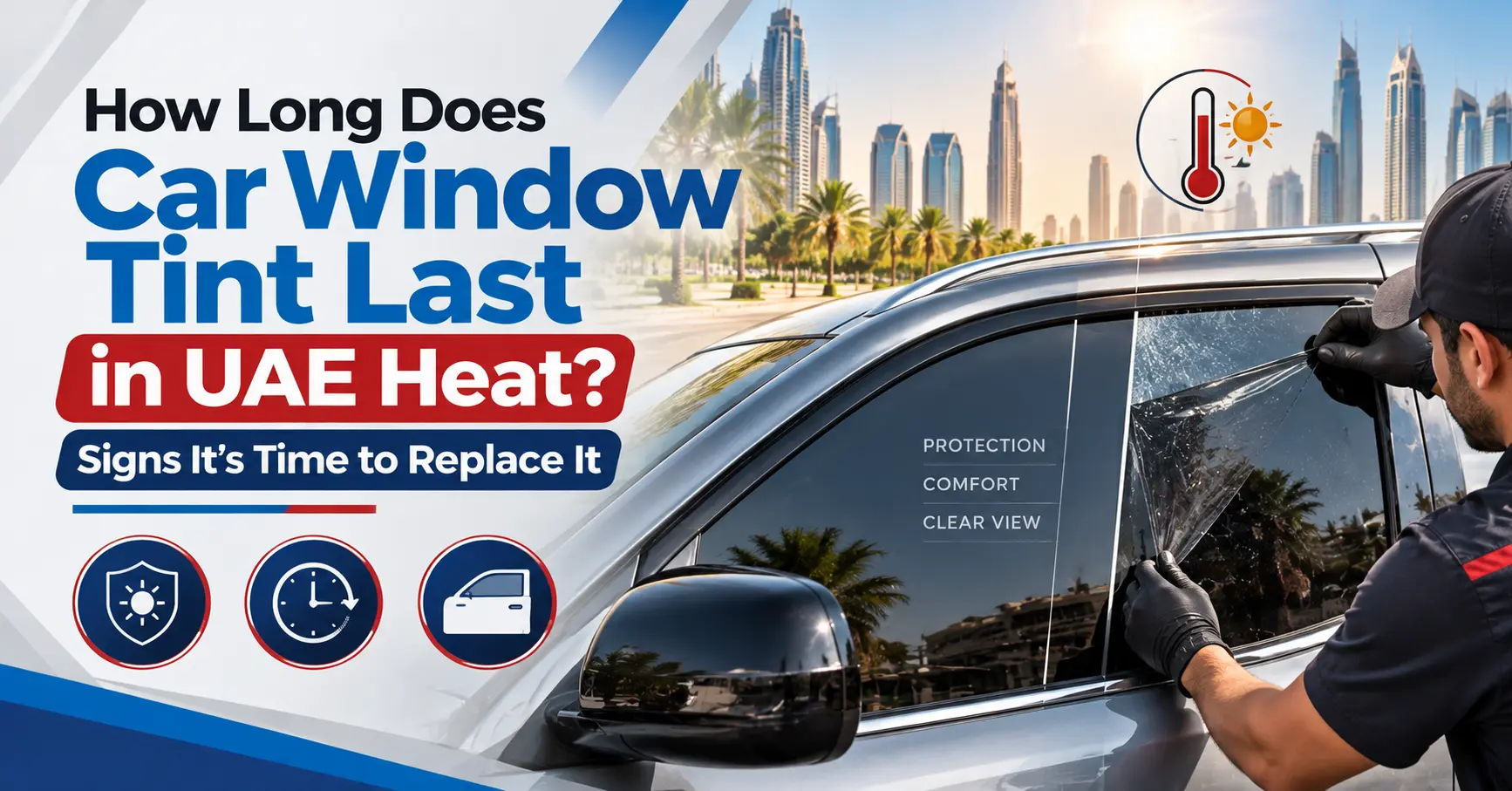
Car window tint can make a noticeable difference in driving comfort by reducing solar heat, glare, and UV exposure. But with the UAE’s intense sunlight and high temperatures, many car owners eventually ask: how long does car window tint last in UAE heat?
The answer depends on the type of window film, film quality, installation method, UV and heat exposure, parking conditions, and maintenance. Lower-cost dyed films may show ageing sooner, while higher-performance ceramic and other color-stable films can remain effective for many years when professionally installed and properly maintained. Manufacturer warranty periods also vary significantly by product and film series.
How Long Does Car Window Tint Last in UAE Heat?
There is no single lifespan that applies to every car window tint.
As a practical guide, many automotive films can fall into these broad ranges:
- Basic dyed films: around 2–5 years, depending on quality and exposure
- Higher-quality hybrid or advanced films: often around 4–7 years
- Premium ceramic films: commonly around 7–10 years or more when properly installed and maintained
These are general expectations rather than guarantees. Some branded films carry warranties that are much longer than these typical service-life ranges. For example, 3M publishes vehicle-owner warranty coverage for certain automotive films that extends for as long as the owner keeps the vehicle, while other 3M automotive films have defined warranty periods. LLumar also provides different warranty coverage depending on its film series.
Quick Answer for UAE Drivers
A good-quality car window tint can last several years in UAE conditions, but the actual lifespan depends mainly on the film type, installation quality, and exposure. If the tint begins bubbling, peeling, fading, turning purple, becoming hazy, or losing its heat-control performance, it may be time for replacement.
Why Does UAE Heat Affect Car Window Tint?
The UAE climate exposes automotive window film to strong and repeated solar loading.
Cars parked outdoors can experience prolonged sunlight through the windshield, side windows, and rear glass. Over time, heat and UV exposure can contribute to changes in the film’s appearance, adhesive performance, and overall condition.
The impact can be greater when a vehicle is:
- Parked outside for long periods
- Exposed to direct sunlight every day
- Driven frequently during peak daytime heat
- Located in a coastal area with higher environmental exposure
- Fitted with lower-quality window film
- Installed using poor-quality materials or techniques
This is why the same type of tint may not perform identically on every vehicle.
7 Signs It’s Time to Replace Your Car Window Tint
Knowing the visible warning signs can help you identify failing window film before it becomes a bigger problem.
1. The Tint Starts Bubbling
Small or large bubbles beneath the film are one of the clearest signs of deterioration.
Bubbles can occur when the film or adhesive begins to lose its proper bond with the glass. Once bubbling becomes significant, the tint can affect the appearance and clarity of the window.
Professional film manufacturers specifically identify bubbling, blistering, delamination, or adhesion failure as conditions covered by some of their warranty programs.
2. The Film Is Turning Purple
A purple, blue, or unusual colour shift is a common visual sign of ageing in some dyed window films.
When the original colour changes significantly, the film is no longer maintaining its intended appearance.
Replacing the damaged film is generally more practical than trying to restore its original colour.
3. The Tint Is Peeling
Edges that begin lifting away from the glass indicate that the film is no longer properly adhered.
You may notice peeling around:
- Window edges
- Corners
- Door glass
- Rear windshield
- Areas exposed to frequent handling
Peeling can continue to spread and may eventually make the whole window look untidy.
4. The Film Looks Hazy or Cloudy
Clear outward visibility is important when driving, particularly at night or in rain.
If the tint develops a cloudy, hazy, or distorted appearance, inspect it carefully. Poor visibility can make driving less comfortable and may be a sign that the film has degraded.
5. Heat Feels Stronger Inside the Car
A tint can still appear dark while its performance has declined.
This is an important point for UAE drivers: darkness and heat rejection are not the same thing.
A window film’s performance can be evaluated using technical measurements such as Total Solar Energy Rejection (TSER), Visible Light Transmission (VLT), and Infrared Energy Rejection (IRER). These measurements help distinguish appearance from actual solar-performance characteristics.
If the cabin starts feeling noticeably hotter despite having the same tint, it may be worth having the film inspected.
6. The Tint Has Scratches or Surface Damage
Minor surface marks may not automatically mean that the entire film has failed.
However, widespread scratches, damaged coating, or visible deterioration can affect appearance and clarity.
This is especially relevant when tint has been cleaned with unsuitable tools or abrasive materials.
7. Different Windows Look Different
If the front, rear, and side windows no longer have a consistent appearance, the film may be ageing unevenly.
Differences can become more noticeable when individual windows were tinted at different times or with different film types.
What Causes Car Window Tint to Fail Faster?
Several factors can shorten the effective life of automotive window film.
Film Quality
Film construction matters.
Lower-cost dyed films can show colour changes and other ageing symptoms sooner than more advanced films. High-performance ceramic and color-stable films are designed for durability and heat-control performance, although exact longevity varies by product.
Installation Quality
Professional installation is important because the film must be properly prepared, applied, and bonded to the glass.
Incorrect preparation, contamination beneath the film, poor edge finishing, or improper application can lead to problems that appear much earlier.
Sun Exposure
A car that spends most of its time outdoors under direct sunlight generally experiences more solar exposure than a vehicle parked indoors or in shaded parking.
Glass Location
Different areas of a vehicle can experience different levels of exposure.
The rear windshield, for example, can experience substantial heat and may also include defroster lines that require careful installation and removal procedures.
Maintenance
Aggressive cleaning techniques, abrasive materials, and incorrect cleaning products can damage the surface of the film over time.
Follow the film manufacturer’s care recommendations.
Does Ceramic Window Tint Last Longer in UAE Heat?
Ceramic window films are widely used for vehicles that need strong solar control, UV protection, and stable appearance.
The exact lifespan still depends on the specific product and installation, but premium ceramic automotive films are commonly marketed and warranted for long-term performance.
For example, 3M’s published warranty information covers certain ceramic and color-stable automotive films for as long as the vehicle owner keeps the vehicle, subject to the warranty terms. LLumar also provides long-term warranty coverage for several ceramic automotive ranges.
That does not mean every ceramic film will perform identically for the same number of years. Always check the manufacturer’s product specifications and warranty conditions.
Ceramic vs Dyed Window Tint: Lifespan and Performance
| Feature | Dyed Film | Ceramic Film |
|---|---|---|
| Typical lifespan | Often shorter | Generally longer |
| Colour stability | More likely to change over time | Generally designed for better colour stability |
| Heat control | Basic to moderate depending on product | Designed for stronger solar and infrared control |
| UV protection | Depends on product | High-performance options can provide strong UV protection |
| Signal interference | Depends on construction | Typically non-metallic |
| UAE suitability | Depends heavily on product quality | Common premium option for heat-focused applications |
The important point is that film category alone does not determine durability. Product quality, installation, maintenance, and warranty coverage should also be considered.
How to Make Car Window Tint Last Longer in UAE
Proper care can help preserve the film’s appearance and performance.
Park in Covered or Shaded Areas
When possible, use covered parking, underground parking, or shade to reduce direct solar exposure.
Use the Right Cleaning Method
Clean tinted glass with products and techniques recommended for automotive window film.
Avoid abrasive sponges, blades, or harsh tools that can scratch the film.
Allow New Tint to Cure Properly
After installation, the film needs time to settle and bond with the glass.
Follow the installer’s recommended curing period before cleaning or operating the windows normally.
Avoid Picking at Film Edges
Do not pull, scratch, or lift loose sections yourself. Damage can spread quickly once the film edge begins separating.
Keep Your Warranty Information
Store the product name, installation date, invoice, and warranty documentation. This can be useful if the film develops an issue covered by the manufacturer.
When Should You Replace Car Window Tint?
You do not necessarily need to replace window tint simply because it has reached a certain age.
Instead, consider age + visible condition + performance.
Replacement becomes more relevant when:
- The film is bubbling
- The film is peeling
- Colour has changed
- Visibility has become hazy
- Heat rejection has noticeably declined
- The film has extensive scratches
- The adhesive is separating
- Different windows have visibly different ageing
A professional inspection can help determine whether the issue is limited to one window or whether the full tint installation should be replaced.
Can You Put New Tint Over Old Tint?
Applying new window film directly over old, deteriorated tint is generally not the preferred solution.
If the existing film is bubbling, peeling, discoloured, or failing, the old material should typically be assessed and removed before installing the replacement film.
Professional removal is especially important on rear glass because improper scraping can damage defroster lines.
A proper replacement process generally involves:
Old Film Inspection → Safe Film Removal → Glass Cleaning → Surface Preparation → New Film Installation → Curing
How to Choose Long-Lasting Car Window Tint in the UAE
When comparing tint options, do not choose solely based on darkness or price.
Look at:
1. Film Type
Ask whether the film is dyed, hybrid, metallic, carbon, ceramic, or another construction.
2. Heat-Rejection Performance
Ask for technical specifications rather than relying only on marketing terms.
Useful measurements can include TSER and IRER.
3. UV Protection
Check the manufacturer’s stated UV-rejection performance.
Some major automotive films publish UV rejection of more than 99%.
4. Warranty
A strong warranty can provide useful protection, but always read the actual coverage conditions and exclusions.
5. Installer Experience
A high-quality film can still produce poor results if installation is not done properly.
Ask about installation experience, product authenticity, curing instructions, and after-installation support.
Is Darker Window Tint Better for UAE Heat?
Not necessarily.
A darker film mainly changes how much visible light passes through the glass. Heat-control performance depends on the film’s overall construction and solar-control properties.
For example, VLT (Visible Light Transmission) describes how much visible light passes through, while TSER and IRER provide additional information about solar and infrared energy performance.
Therefore, when choosing tint for UAE conditions, focus on measured performance, film quality, visibility, and the manufacturer’s specifications, rather than darkness alone.
Car Window Tint Replacement for Dubai, Abu Dhabi, Sharjah and Ajman
The same basic inspection principles apply across the UAE.
Whether you drive in Dubai, Abu Dhabi, Sharjah, Ajman, or another UAE location, look for the same signs of film deterioration:
Bubbles → Peeling → Purple Discolouration → Hazy Visibility → Reduced Performance → Replacement
Local climate exposure, parking habits, vehicle usage, and film quality can all influence how quickly those signs appear.
Frequently Asked Questions
How long does car window tint last in UAE heat?
A quality automotive window tint can last several years in UAE conditions. Lower-cost dyed films may require replacement sooner, while premium ceramic and other advanced films can provide longer service life. Actual longevity depends on film quality, installation, exposure, and maintenance.
How often should car window tint be replaced?
There is no universal replacement schedule. Inspect the film based on its age, appearance, visibility, adhesion, and heat-control performance. Replace it when significant deterioration appears.
Why does window tint turn purple?
Purple discolouration is commonly associated with ageing of some dyed window films. It indicates that the film’s original colour stability has deteriorated.
Does ceramic tint last longer than regular tint?
Premium ceramic films are generally designed for long-term colour stability and performance, and several major manufacturers offer long warranty coverage on ceramic automotive films. Exact durability depends on the specific product and installation.
Does old window tint reduce visibility?
It can. Peeling, bubbling, haze, scratches, or colour changes can affect the visual clarity of the glass, particularly at night or in difficult weather conditions.
Can damaged tint be repaired?
Minor issues may sometimes be limited to a particular section, but bubbling, peeling, severe discolouration, or widespread adhesive failure generally indicate that replacement is more appropriate than attempting a cosmetic repair.
How can I make my car tint last longer?
Use quality film, have it professionally installed, follow curing instructions, clean it with suitable products, avoid abrasive tools, and use shaded or covered parking when possible.
Final Takeaway
So, how long does car window tint last in UAE heat?
There is no single number for every vehicle. A reasonable expectation is several years for quality automotive film, with lower-cost dyed products generally ageing sooner and premium ceramic films potentially lasting much longer when properly installed and maintained.
The most important thing is not simply how old the tint is. Look for bubbling, peeling, purple discolouration, haze, scratches, uneven appearance, or declining heat-control performance.
When replacing your tint, compare the film type, technical performance, warranty, installation quality, and expected durability rather than choosing only by price or darkness.
For UAE driving conditions, a professionally installed, high-quality film can provide a better long-term combination of heat control, UV protection, visibility, comfort, and appearance.