

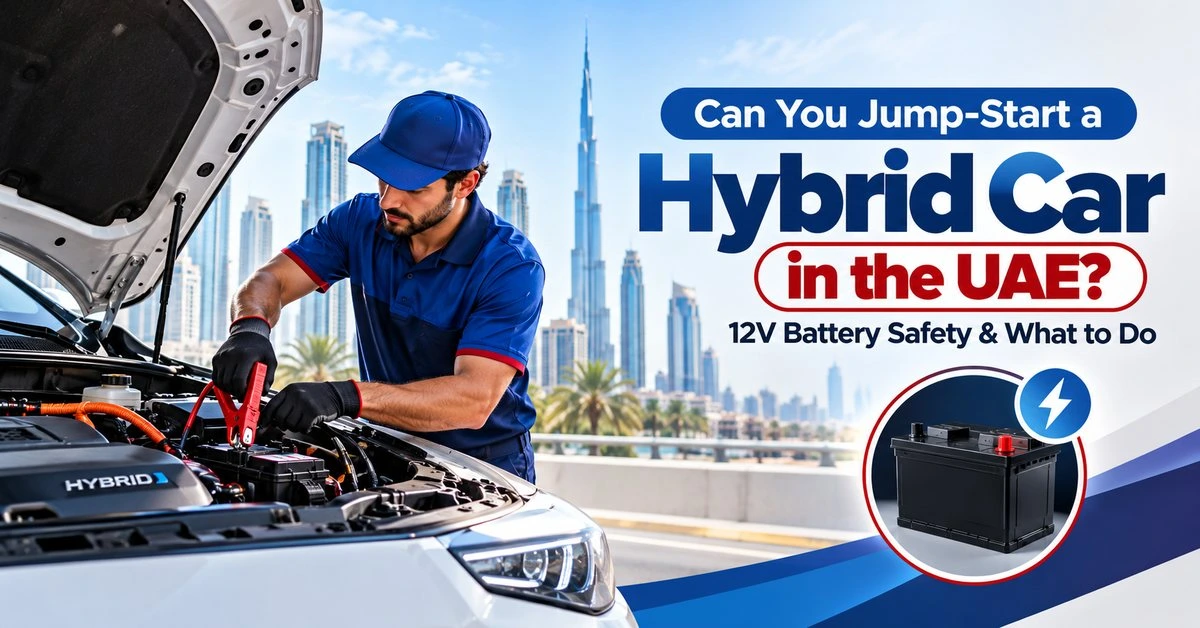
If your hybrid car will not start, a weak 12V battery could be the reason. Before attempting a restart, it is important to understand how hybrid vehicle batteries work and which components can be jump-started safely. A professional car battery jump-start service can help drivers in the UAE when the vehicle’s low-voltage battery is discharged, provided the vehicle supports the procedure and the manufacturer’s instructions are followed.
So, can you jump-start a hybrid car? Yes, many hybrid cars can be jump-started when their 12V auxiliary battery is discharged. However, the procedure differs between models, and it does not involve jump-starting the high-voltage hybrid battery.
Understanding this difference can help you avoid incorrect connections and unnecessary damage to your vehicle’s electrical system.
Can You Jump-Start a Hybrid Car?
Yes, many hybrid vehicles can receive a jump-start when the 12V auxiliary battery is too weak to power the vehicle’s electronic systems.
The 12V battery supports functions such as control modules, dashboard electronics, security systems and the process of switching the hybrid system on.
When this battery becomes discharged, the car may not recognise the key, display dashboard information or enter its normal operating mode—even if the high-voltage hybrid battery has charge remaining.
A correctly performed jump-start may restore enough low-voltage power for the hybrid system to start.
However, not every no-start problem is caused by the 12V battery. If the vehicle has a hybrid-system fault, a high-voltage battery issue or another electrical problem, a jump-start may not help.
Important: Always check your specific vehicle’s owner’s manual before attempting a jump-start. The approved connection points and procedure can vary by make, model and year.
Understanding the Two Batteries in a Hybrid Car
To understand hybrid battery safety, you first need to distinguish between the two battery systems.
1. The 12V Auxiliary Battery
The 12V battery powers many of the vehicle’s low-voltage electrical systems. Depending on the design, it may be located under the bonnet, in the boot or beneath a panel.
If this battery becomes discharged, the car may not enter its ready-to-drive state.
Common symptoms include:
- Dashboard lights failing to illuminate normally.
- The car not responding to the start button.
- The electronic key or door-locking system behaving abnormally.
- Warning messages appearing after a low-voltage event.
- The vehicle failing to enter READY mode.
These symptoms can indicate a discharged 12V battery, but they do not prove that the battery is the only problem.
2. The High-Voltage Hybrid Battery
The high-voltage battery is part of the hybrid propulsion system. It works with the electric motor and other vehicle components to support driving.
The high-voltage hybrid battery must not be treated like a conventional 12V battery.
Do not attempt to connect ordinary jump leads or a portable 12V booster to the high-voltage battery or its associated wiring.
High-voltage components can present serious electrical hazards. If you suspect a fault in the hybrid battery or high-voltage system, contact an appropriately qualified hybrid vehicle technician.
Why Won’t Your Hybrid Car Start?
A hybrid car that fails to start may have several different problems.
A Discharged 12V Battery
Leaving lights or other electrical equipment on, extended parking or battery deterioration can cause the 12V battery to lose charge.
This is one reason a hybrid may appear completely unresponsive even when its main battery still has charge.
An Ageing Battery
Like other automotive batteries, a hybrid’s 12V auxiliary battery can lose its ability to hold sufficient charge over time.
If the same problem happens repeatedly, arrange a battery health test instead of relying on jump-starts.
A Charging-System Problem
A hybrid may use a DC-DC converter or another vehicle-specific system to maintain the 12V battery rather than a conventional alternator arrangement.
If the low-voltage battery is not being charged correctly, it can become discharged again after a jump-start.
A Key or Electrical-System Issue
A faulty key, electrical connection, fuse, control module or another component can also prevent the vehicle from starting.
A Hybrid-System Fault
If the 12V battery is functioning correctly but the vehicle still will not enter READY mode, the issue may require a hybrid-system diagnosis.
The correct approach is to identify the cause instead of repeatedly attempting to restart the vehicle.
How to Jump-Start a Hybrid Car Safely
The exact procedure depends on your vehicle, so the instructions below are safety checks, not a substitute for your manufacturer’s model-specific procedure.
Step 1: Park Safely
Move the vehicle away from traffic if possible. Select Park, apply the parking brake and switch off electrical accessories.
If you are stranded in an unsafe roadside location, prioritise your safety and arrange roadside assistance.
Step 2: Check the Owner’s Manual
Locate the section covering a discharged 12V battery or emergency starting.
Some hybrids have a dedicated positive jump-start terminal under the bonnet, even when the 12V battery itself is located elsewhere.
Do not assume that the battery’s physical location identifies the correct connection points.
Step 3: Inspect the 12V Battery
Do not attempt to jump-start a battery that is swollen, cracked, leaking or visibly damaged. If you notice unusual heat, a strong chemical smell or damaged electrical components, stop and seek professional assistance.
Step 4: Use the Correct 12V Power Source
Use only the voltage and equipment permitted by the vehicle manufacturer.
A compatible booster pack or a suitable donor vehicle may be permitted, depending on the vehicle’s instructions.
Do not use an unapproved voltage source or guess the correct terminals.
Step 5: Follow the Specified Connection Procedure
Connect the leads only to the designated positive terminal and grounding point identified in the owner’s manual.
Incorrect polarity or an unsuitable grounding point can damage electronic components.
If the correct points are unclear, do not guess. Call a qualified technician.
Step 6: Check the Hybrid System
Follow the manufacturer’s starting instructions. On many hybrids, the important confirmation is that the READY indicator appears, not necessarily that the petrol engine immediately starts running.
The petrol engine may remain off when the vehicle is ready to drive.
If READY does not appear or a serious warning remains, stop attempting further restarts and arrange professional diagnosis.
Step 7: Disconnect and Check the Vehicle
Disconnect the equipment in the order specified by the vehicle and booster instructions.
After the vehicle starts, arrange a battery and charging-system check, especially if the 12V battery became fully discharged or the problem has occurred before.
Can You Jump-Start a Hybrid Car Using Another Hybrid?
Do not assume that one hybrid can safely jump-start another vehicle.
Some hybrid models provide a designated jump-start point for receiving power but do not permit the vehicle to be used as a donor for another car. The design and permitted procedure vary.
Using a hybrid as a donor without manufacturer approval could damage its electrical system.
The safer approach is to check the owner’s manual of the proposed donor vehicle and use only a method explicitly permitted by the manufacturer.
Can You Jump-Start an Electric Vehicle the Same Way?
Not necessarily.
Hybrid electric vehicles, plug-in hybrids and fully electric vehicles have different electrical architectures. Some have a conventional 12V auxiliary battery, while others use different low-voltage arrangements.
Even when a vehicle has a 12V system, that does not mean every jump-start or battery-donor procedure is permitted.
For a fully electric vehicle or plug-in hybrid, follow the exact manufacturer’s emergency-starting instructions. Never use the high-voltage traction battery as a connection point for a conventional jump-start.
What Should You Never Do When Jump-Starting a Hybrid?
Avoid these common mistakes:
Do not touch high-voltage wiring. Orange high-voltage cables and associated components must be left to appropriately qualified personnel.
Do not guess the battery location. The auxiliary battery may be inside the vehicle or in the boot, and a dedicated jump terminal may be provided elsewhere.
Do not reverse the connections. Incorrect polarity can damage vehicle electronics.
Do not use an unapproved power source. Follow the manufacturer’s voltage and equipment requirements.
Do not jump-start a damaged battery. Swelling, cracking and leakage are reasons to stop.
Do not assume the problem is solved once the vehicle starts. A discharged battery may indicate battery deterioration or a charging-system fault.
Do not keep trying if the vehicle will not enter READY mode. Repeated attempts may not help when another fault is present.
Why Is Hybrid Battery Safety Important in the UAE?
Hybrid vehicles are used across the UAE for commuting, family travel and business journeys. A no-start problem can occur at home, in office parking, at a shopping centre or on the roadside.
Heat, battery age, driving patterns, electrical load and extended parking can all influence low-voltage battery performance. However, a hot climate alone does not confirm that the battery has failed.
If your hybrid car is unresponsive, first consider whether the 12V auxiliary battery may be discharged. Then follow the model-specific procedure or seek professional assistance.
Drivers in Sharjah, Dubai and Ajman can also consider mobile jump-start assistance when the vehicle cannot conveniently be taken to a workshop.
Al Bayan Battery Experts provides mobile car battery jump-start assistance across Sharjah, Ajman and Dubai. For hybrid vehicles, make the vehicle’s exact make, model and year clear when requesting assistance so the appropriate procedure can be confirmed.
What Should You Do After a Hybrid Car Jump-Starts?
Getting the vehicle into READY mode is only the first step.
If the 12V battery was discharged, arrange a battery test to determine whether it can still hold sufficient charge.
A technician may also need to check:
- Battery condition and voltage.
- Battery terminals and electrical connections.
- The vehicle’s 12V charging system.
- The DC-DC converter where applicable.
- Electrical drain while the vehicle is parked.
- Relevant dashboard warnings or diagnostic fault codes.
If the vehicle starts successfully but becomes unresponsive again after parking, the cause should be investigated.
Repeated jump-starts are not a long-term solution for an ageing battery or an unresolved electrical fault.
For further information on identifying battery problems, read our guide to when your car battery needs replacement in the UAE.
When Should You Call a Professional?
Arrange professional help if:
- You cannot identify the approved jump-start points.
- The 12V battery is damaged or leaking.
- The vehicle displays a hybrid-system warning.
- The car still will not enter READY mode after a permitted jump-start.
- The battery repeatedly becomes discharged.
- You suspect a high-voltage battery or electrical-system fault.
- You are unsure whether the proposed booster or donor vehicle is compatible.
A technician can assess whether the problem involves the 12V battery, connections, charging system or another fault and determine the appropriate next step.
Frequently Asked Questions
Can a hybrid car be jump-started if the main battery is charged?
Yes, if the problem is a discharged 12V auxiliary battery and the manufacturer’s procedure supports jump-starting. A charged high-voltage battery does not necessarily provide the low-voltage power needed to activate the vehicle’s electronics.
Does jump-starting a hybrid car charge its main battery?
No. A conventional 12V jump-start is intended to restore power to the low-voltage system. It does not directly charge the high-voltage traction battery.
Where is the 12V battery located in a hybrid car?
The location varies by model. It may be under the bonnet, in the boot or beneath an interior panel. Some vehicles have a dedicated jump-start terminal in a different location.
Can I use a portable jump starter on a hybrid car?
A compatible 12V booster may be suitable for some hybrid models. Check the owner’s manual for the permitted voltage, connection points and procedure before use.
Can a hybrid car jump-start a normal petrol car?
Not always. Some hybrid manufacturers do not permit their vehicles to be used as donor vehicles. Check the exact donor vehicle’s manual before attempting it.
Why does my hybrid car still not start after a jump-start?
Possible causes include a weak or defective 12V battery, incorrect connections, a charging-system fault, a key-related issue or another vehicle-system problem. If the car does not enter READY mode, arrange professional diagnosis.
Should I replace the 12V battery after every jump-start?
No. A jump-start alone does not mean the battery must be replaced. Testing can help determine whether it needs charging, replacement or further investigation.
Is it safe to jump-start a hybrid car in the UAE?
It can be safe when the specific vehicle supports the procedure and the manufacturer’s instructions are followed. If the battery is damaged, the connection points are unclear or a hybrid-system fault is suspected, seek professional assistance.

