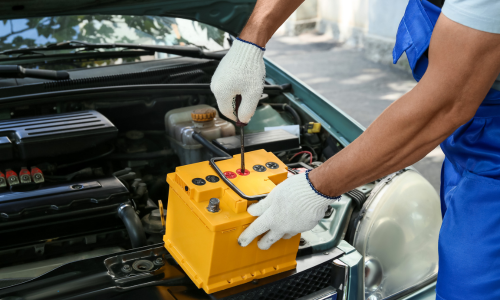
Replacing a car battery is not always as simple as removing the old battery and fitting a new one. Modern vehicles may use battery management systems, intelligent charging systems, and start-stop technology, which can make replacement more than a simple physical installation. During car battery installation, confirm that the replacement battery matches the vehicle’s required specifications and check whether the vehicle needs battery registration, coding, or adaptation after installation.
So, does every car need battery registration after a battery replacement in the UAE?
No. The requirement depends on the vehicle’s make, model, year, electrical system, battery technology and manufacturer-specific setup.
Understanding this difference can help you avoid unnecessary procedures while also preventing an incomplete battery replacement on vehicles that do require electronic registration.
What Is Battery Registration After Replacement?
Battery registration is an electronic procedure used on certain vehicles to inform the vehicle’s battery-management or power-management system that a new battery has been installed.
The vehicle may monitor information related to battery condition, charging and electrical demand. When an old battery is replaced, the system may need to update its stored information so that it can manage the replacement battery correctly.
This is particularly relevant in vehicles with advanced battery monitoring and energy-management systems.
Battery registration is not the same as registering a vehicle with the UAE authorities. It is an automotive diagnostic procedure performed within the vehicle’s electronic system.
Does Every Car Need Battery Registration?
No.
Many conventional vehicles can have a battery replaced without a separate electronic registration procedure. However, some newer vehicles use battery-management systems that require a registration, adaptation or reset after replacement.
The requirement can depend on:
- Vehicle make and model
- Model year
- Engine and electrical configuration
- Start-stop system
- Battery monitoring system
- Original battery technology
- Replacement battery capacity and specification
This means you should not assume that every BMW, Mercedes, Toyota, Audi or other vehicle either always needs or never needs battery registration.
The requirement should be checked for the specific vehicle.
Why Do Some Cars Need Battery Registration?
Modern vehicles have much greater electrical demands than older vehicles.
A vehicle’s battery can support systems such as:
- Engine starting
- Lighting
- Infotainment
- Electronic control modules
- Security systems
- Sensors
- Climate-control systems
- Start-stop functions
- Other electrical equipment
The charging system also needs to manage the battery according to the vehicle’s electrical requirements.
When the old battery is replaced, certain vehicles need their electronic system to recognise that the battery is new. On some systems, this process is referred to as battery registration. On others, the required procedure may be called battery adaptation, coding or BMS reset.
The terminology can vary, so the correct procedure matters more than the name used.
Battery Registration vs Coding vs Adaptation
These terms are often confused, but they can refer to different procedures.
| Procedure | General Meaning |
|---|---|
| Battery Replacement | Physically removing the old battery and installing a new one |
| Battery Registration | Informing the vehicle that the battery has been replaced |
| Battery Adaptation | Updating battery-related information within the vehicle’s system |
| Battery Coding | Configuring battery characteristics where the vehicle requires it |
| BMS Reset | Resetting or updating battery-management information on supported vehicles |
Not every vehicle requires all of these procedures.
For example, a vehicle may only need registration when a battery of the same specification is installed, while another vehicle may require additional adaptation when the battery type or capacity changes.
Which Cars May Need Battery Registration?
Battery registration is more commonly associated with vehicles that have sophisticated battery monitoring and energy-management systems.
It can be found on certain modern vehicles from manufacturers such as:
- BMW
- Mercedes-Benz
- Audi
- Volkswagen
- Porsche
- Volvo
- Jaguar
- Land Rover
- MINI
However, these brand names should only be used as examples.
The presence of a particular brand does not automatically mean registration is required.
The exact requirement can vary between models, production years, engine versions and electrical configurations.
That is why checking the vehicle’s specific system is more reliable than following a general brand-based rule.
Do Start-Stop Cars Need Battery Registration?
Not necessarily.
A start-stop system is an indication that the vehicle may have more advanced battery and charging requirements, but it does not automatically mean that every start-stop vehicle needs battery registration.
These vehicles may use battery technologies such as:
AGM Batteries
Absorbent Glass Mat (AGM) batteries are commonly used in vehicles with higher electrical demands and some start-stop applications.
EFB Batteries
Enhanced Flooded Battery (EFB) technology is also used in many vehicles equipped with start-stop systems.
The replacement battery needs to be suitable for the vehicle’s specified battery technology and electrical requirements.
Installing a battery simply because it fits physically is not always enough.
What Happens If a New Battery Is Not Registered?
This depends on the vehicle.
On some vehicles, no separate registration may be necessary. On vehicles where a battery-management procedure is required, failing to complete it can affect how the vehicle manages the replacement battery.
Depending on the system, drivers may experience issues such as:
- Start-stop function becoming unavailable
- Battery-management warnings
- Charging-related issues
- Stored fault codes
- Incorrect battery-management behaviour
- Repeated battery discharge in some situations
However, it is important not to assume that every battery problem after replacement is caused by missing registration.
A problem could also come from an incorrect battery specification, charging-system fault, poor connection, battery-monitoring issue or another electrical problem.
Can Battery Registration Fix a Weak Battery?
No.
Battery registration does not repair a physically weak or defective battery.
If the battery has reached the end of its service life, registration will not make the old battery healthy again.
A proper process should be:
Test the battery → Confirm the cause → Select the correct replacement → Install the battery → Register or adapt it if required → Check the charging system
This is particularly important when a vehicle has experienced repeated battery failures.
Should the Battery Be Tested Before Replacement?
Yes.
A battery that will not start a car is not necessarily a failed battery.
The problem could involve:
- Low state of charge
- Alternator problems
- Loose or corroded terminals
- Excessive electrical drain
- Starter-related problems
- Battery ageing
- Incorrect battery specification
A battery and charging-system test can help identify whether replacement is actually necessary.
This also prevents a situation where a new battery is installed but the underlying electrical problem remains.
Does the New Battery Have to Match the Old Battery?
The replacement battery should meet the vehicle’s required specifications.
Important characteristics can include:
Battery Capacity
Usually expressed in Ah (ampere-hours), capacity must be appropriate for the vehicle’s requirements.
Starting Performance
CCA (Cold Cranking Amps) indicates the battery’s starting capability under specified testing conditions.
Battery Technology
The vehicle may require a conventional lead-acid battery, EFB, AGM or another specified technology.
Physical Size
The replacement must fit securely in the designated battery compartment.
Terminal Configuration
The terminal position and connection arrangement must be compatible.
Vehicle-Specific Requirements
Some vehicles have additional battery-management requirements that need to be considered during installation.
Choosing a battery only because the dimensions look similar can lead to compatibility problems.
Is Battery Coding Necessary When Changing Battery Size?
Possibly.
This is one of the situations where professional diagnosis becomes important.
For example, changing battery capacity or switching between battery technologies can require additional adaptation or configuration on some vehicles.
The exact procedure depends on the vehicle’s electronic architecture.
Therefore, replacing an AGM battery with a different type, changing capacity, or selecting a battery based only on price should not be done without checking the vehicle requirements first.
Does Battery Registration Require an OBD Scanner?
For vehicles that require electronic registration or adaptation, a compatible diagnostic tool is generally used.
The technician connects the diagnostic equipment to the vehicle’s diagnostic system and follows the appropriate battery-management procedure.
However, not every basic OBD scanner can perform battery registration.
A device that can only read or clear fault codes may not have the required battery-management functions.
This is why the important question is not simply:
“Do you have an OBD scanner?”
Instead, ask:
“Can you perform the required battery registration or adaptation for my exact vehicle?”
Battery Registration in the UAE: What Drivers Should Know
Battery replacement in the UAE often happens outside a traditional workshop. A vehicle may stop working at home, at an office, in basement parking, at a shopping centre or on the roadside.
For this reason, mobile battery service can be useful when both battery replacement and diagnostic checks are needed at the vehicle’s location.
Before requesting service, provide:
- Vehicle make
- Exact model
- Model year
- Engine type where relevant
- Current battery information
- Your location
- Symptoms you are experiencing
This helps the technician determine the likely battery requirements before arriving.
For example, a vehicle with a start-stop system may require a different battery technology from a conventional vehicle, while certain electronically managed vehicles may require a registration or adaptation procedure after installation.
What Should You Ask Before Replacing Your Car Battery?
Before agreeing to a replacement, ask these questions:
1. Is the battery definitely the problem?
A battery test can help distinguish a weak battery from a charging-system or electrical problem.
2. Which battery specification does my vehicle require?
Confirm the correct capacity, starting performance, technology and physical fit.
3. Does my vehicle need battery registration?
This depends on the vehicle’s system.
4. Does it need coding or adaptation as well?
This can be important when battery specifications change.
5. Is the procedure included with installation?
Clarifying this before the technician arrives can avoid unexpected service requirements.
6. Will the charging system be checked?
A faulty charging system can cause problems even with a new battery.
Can Battery Registration Be Done During Mobile Battery Installation?
On vehicles that support the required mobile diagnostic procedure, registration or adaptation may be completed at the vehicle’s location.
This can be convenient when the car cannot be driven to a workshop.
A proper mobile battery installation should involve more than simply connecting a new battery. The technician should confirm the correct battery specification, install it securely and check the vehicle’s electrical and charging systems.
For vehicles that require battery registration, the appropriate diagnostic procedure can then be completed as part of the installation process.
Al Bayan Battery Experts provides mobile battery installation and replacement services in Sharjah, Dubai and Ajman, with battery testing, battery specification checks and charging-system checks as part of its service process. Battery Experts UAE
What Is the Correct Battery Replacement Process?
A professional battery replacement can generally follow this sequence:
Step 1: Diagnose the Problem
Test the existing battery and check whether the problem is actually battery-related.
Step 2: Confirm Battery Specification
Check the required battery size, capacity, CCA, technology and vehicle compatibility.
Step 3: Remove the Old Battery Safely
Disconnect and remove the old battery using the appropriate procedure for the vehicle.
Step 4: Install the New Battery
Secure the battery correctly and ensure the terminals and connections are properly fitted.
Step 5: Register or Adapt the Battery
Where required, complete the vehicle-specific battery-management procedure.
Step 6: Check the Charging System
Verify that the alternator and charging system are functioning correctly.
Step 7: Final System Check
Confirm that the vehicle starts properly and check for relevant warning messages or electrical issues.
This approach is more useful than treating every battery replacement as a simple physical swap.
Common Mistakes to Avoid After Battery Replacement
Assuming Every Car Needs Registration
Not every vehicle requires battery registration.
Assuming No Car Needs Registration
Modern vehicles with battery-management systems may require a specific procedure.
Choosing a Battery Only by Price
The cheapest battery is not necessarily the correct battery for the vehicle.
Ignoring Battery Technology
A vehicle designed for AGM or EFB may have specific battery requirements.
Replacing the Battery Without Testing
The actual problem may be the alternator, electrical drain, starter system or connection.
Assuming a Basic OBD Scanner Can Do Everything
Not every diagnostic device supports battery registration or adaptation.
Ignoring Repeated Battery Failure
A new battery that repeatedly becomes weak should be investigated rather than repeatedly replaced.
Does UAE Heat Make Battery Registration More Important?
The UAE’s climate can place significant demands on vehicle batteries, but temperature itself does not determine whether battery registration is required.
Registration is primarily related to the vehicle’s electronic battery-management requirements.
Climate, driving conditions, electrical load and battery condition are separate factors that can influence battery performance and service life.
Therefore, UAE drivers should consider both:
Battery condition + Vehicle battery-management requirements
rather than assuming that heat alone means a particular battery or registration procedure is necessary.
Final Answer: Does Your Car Need Battery Registration After Replacement?
Not every car needs battery registration after a battery replacement.
Some vehicles can operate normally after a correctly fitted replacement battery without a separate registration procedure. Others use battery-management systems that require the replacement battery to be registered, adapted or coded.
The requirement depends on the specific vehicle, not simply the battery brand or the fact that the vehicle is new.
Before replacing the battery, the better approach is to:
Test the battery → Confirm the correct specification → Install the correct battery → Register or adapt it if required → Check the charging system
For UAE drivers, this is especially useful when dealing with modern vehicles equipped with start-stop technology or advanced electrical management.
If your vehicle needs a replacement, car battery installation should include more than simply fitting a battery. The correct battery specification, secure installation, charging-system condition and any required electronic procedure should all be considered.
Frequently Asked Questions
Does every car need battery registration after replacement?
No. Battery registration is required only on vehicles whose battery-management system calls for the procedure.
How do I know if my car needs battery registration?
The requirement depends on the exact make, model, year and battery-management system. A qualified technician can check the vehicle before or during replacement.
Is battery registration the same as battery coding?
Not necessarily. Registration generally confirms the replacement, while coding or adaptation can involve configuring battery-related information. The exact terminology depends on the vehicle.
Do start-stop cars need battery registration?
Not automatically. Start-stop vehicles can have specific battery and charging requirements, but the need for registration depends on the particular vehicle.
Does an AGM battery need registration?
An AGM battery itself does not automatically require registration. The vehicle’s battery-management system determines whether registration or adaptation is required.
Can a new battery work without registration?
On some vehicles, yes. On vehicles that require a battery-management procedure, the appropriate registration or adaptation should be completed.
Can battery registration be done at the vehicle location?
For supported vehicles, mobile technicians with suitable diagnostic equipment may be able to perform the required procedure at the vehicle’s location.
Can battery registration fix a battery that keeps going flat?
No. Registration does not repair an underlying battery, alternator or electrical problem. Repeated battery discharge should be properly diagnosed.
Do I need battery registration if I replace the battery with the same type?
Possibly. Even when the replacement has the same technology and capacity, some vehicles still require the new battery to be electronically registered.